Sync Engine
How Context Teleport uses git for synchronization, including push/pull internals, section-level merge, and conflict resolution strategies.
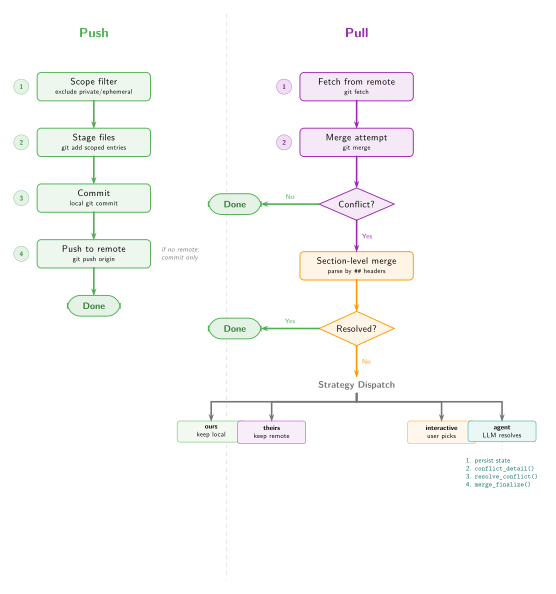
Overview
Context Teleport uses git as its transport layer. The GitSync class (src/ctx/sync/git_sync.py) wraps git operations and adds:
- Scope-aware staging: Only public files are staged for push
- Section-level merge: Markdown files merge at
##section granularity - Multi-strategy conflict resolution: ours, theirs, interactive, agent
- Persistent conflict state: Survives across MCP calls for agent-based resolution
Push flow
context_sync_push(message="Add architecture knowledge")
    |
    v
GitSync.push()
    |
    1. Scope filter -- read .scope.json, exclude private/ephemeral files
    2. Stage filtered files -- git add (only public content)
    3. Commit -- auto-generate message if empty
    4. Push -- git push to remote (if remote exists)
    |
    v
Result: {"status": "pushed"} or {"status": "committed"} (no remote)
If there is no remote configured, push still commits locally and returns {"status": "committed"}. This means the sync tools work in offline/local-only scenarios.
Pull flow
context_sync_pull(strategy="ours")
    |
    v
GitSync.pull()
    |
    1. Fetch from remote -- git fetch
    2. Attempt merge -- git merge
    |
    +-- Clean merge? --> Done: {"status": "pulled"}
    |
    +-- Conflicts?
        |
        +-- Try section-level merge for .md files
        |   |
        |   +-- All sections resolved? --> Done
        |   +-- Conflicts remain? --> Fall through to strategy
        |
        +-- Apply strategy
            |
            +-- ours: keep local version
            +-- theirs: take remote version
            +-- interactive: TUI prompt per file
            +-- agent: persist state, return conflict report
Section-level merge
The key innovation in Context Teleport's sync is section-level merge for markdown files (src/ctx/core/merge_sections.py).
How it works
Instead of treating the entire file as a unit, the merge engine:
- Parses base, ours, and theirs versions into sections (split on
##headers) - Compares each section independently using content equality
- Merges section by section:
- Section unchanged in both: keep as-is
- Section changed in only one side: take the changed version
- Section changed in both sides: conflict (only for this section)
- New sections: include from whichever side added them
Why this matters
Without section-level merge, two agents editing different parts of knowledge/architecture.md would produce a file-level conflict:
Agent A adds "## API Guidelines" section
Agent B adds "## Caching Strategy" section
  --> File-level conflict (both modified the same file)
With section-level merge, these auto-resolve because the changes are in different sections.
Implementation details
- Trailing whitespace is normalized via
_content_eq()to avoid false conflicts from section boundary shifts - Sections are identified by
##prefix (level-2 headers) - Content before the first
##header is treated as a "preamble" section - Integration point:
GitSync.pull()calls_try_section_merge()before falling back to file-level strategy
Conflict resolution strategies
ours (default)
Keep the local version for all conflicted files. The remote changes are discarded for conflicting files only -- non-conflicting changes from the remote are still applied.
theirs
Take the remote version for all conflicted files. Local changes are discarded for conflicting files.
interactive
Presents a TUI prompt for each conflicted file, showing both versions. The user chooses which to keep or can edit manually. Only available via CLI, not MCP.
agent (LLM-based)
The most sophisticated strategy. Instead of resolving immediately, it persists the conflict state and returns a report for the agent to handle.
Agent conflict resolution
When strategy=agent is used, the flow becomes a multi-step process across MCP calls:
Step 1: Pull with agent strategy
context_sync_pull(strategy="agent")
  --> Returns: {"status": "conflicts", "report": {...}}
  --> Persists: .context-teleport/.pending_conflicts.json (gitignored)
The ConflictReport contains:
conflict_id: UUID for this merge operationconflicts: list ofConflictEntryobjects, each with:file_path: relative pathours_content: local versiontheirs_content: remote versionbase_content: common ancestorresolved: booleanresolution: resolved content (when resolved)
Step 2: Examine each conflict
context_conflict_detail(file_path="knowledge/architecture.md")
  --> Returns: {
        ours_content, theirs_content, base_content,
        diff (unified format),
        section_analysis (for .md files): {
          has_section_conflicts, conflict_details, auto_merged_content
        }
      }
For markdown files, the section analysis shows whether section-level merge can auto-resolve the conflict. If has_section_conflicts is False, the auto_merged_content can be used directly.
Step 3: Resolve each file
context_resolve_conflict(
    file_path="knowledge/architecture.md",
    content="...merged content..."
)
  --> Updates the ConflictEntry, persists to disk
  --> Returns: {"status": "resolved", "remaining": N}
Step 4: Finalize
context_merge_finalize()
  --> Applies all resolutions to working tree
  --> Falls back to 'ours' for any unresolved files
  --> Commits the merge
  --> Clears .pending_conflicts.json
Abort
At any point, the agent can abort:
Persistent conflict state
Conflict state is stored in .context-teleport/.pending_conflicts.json, which is gitignored. This is necessary because:
- MCP tools are stateless -- each call is independent
- The agent may need multiple turns to examine and resolve conflicts
- The state must survive across tool invocations
The ConflictReport serializes to JSON via to_json()/from_json() methods, with UUIDs as conflict_id values for disk round-trips.
Auto-push on shutdown
The MCP server's _server_lifespan context manager performs a best-effort push on shutdown:
@asynccontextmanager
async def _server_lifespan(app):
    try:
        yield
    finally:
        try:
            gs = GitSync(store.root)
            if gs._has_changes():
                gs.push()
        except Exception:
            pass  # Best-effort, don't block shutdown
This catches the case where an agent made changes but forgot to push. The operation is silent on failure (e.g., no remote, auth issues, network down).