Skill Lifecycle
The full lifecycle of an agent skill, from creation through usage tracking, feedback, improvement proposals, and upstream contribution.
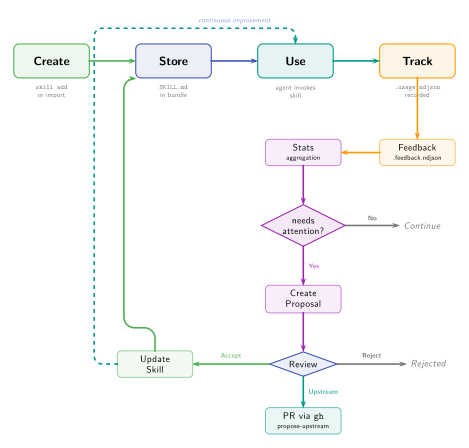
Overview
Skills go through a continuous improvement cycle:
Each stage produces data that feeds back into the cycle, enabling skills to evolve based on actual usage patterns and agent feedback.
Stage 1: Creation
Skills can be created through multiple paths:
Via MCP tool (most common):
context_add_skill(
    name="deploy-staging",
    description="Deploy to staging environment",
    instructions="## Steps\n1. Run tests\n2. Build image\n..."
)
The tool constructs the SKILL.md file with YAML frontmatter automatically via build_frontmatter().
Via CLI:
Accepts content from --file, stdin, or opens $EDITOR.
Via adapter import:
Imports skills from .claude/skills/*/SKILL.md.
Stage 2: Storage
Skills are stored as directories in the context bundle:
.context-teleport/
  skills/
    deploy-staging/
      SKILL.md              # YAML frontmatter + markdown body
      .usage.ndjson          # Created lazily on first use
      .feedback.ndjson       # Created lazily on first rating
      .proposals/            # Created lazily on first proposal
    .scope.json              # Scope metadata for all skills
The SkillEntry model tracks:
| Field | Description |
|---|---|
name | Directory name, used as identifier |
description | From YAML frontmatter |
content | Full SKILL.md file content |
updated_at | Last modification timestamp |
agent | Agent that last wrote the skill |
Stage 3: Usage tracking
When an agent uses a skill, it records a usage event:
This appends a SkillUsageEvent to .usage.ndjson:
Usage data drives:
- Adoption metrics: Which skills are actually being used
- Frequency patterns: How often each skill is invoked
- Agent distribution: Which agents use which skills
Stage 4: Feedback
After using a skill, agents rate its quality:
context_rate_skill(skill_name="deploy-staging", rating=4, comment="Clear steps, needs rollback section")
This appends a SkillFeedback entry to .feedback.ndjson:
{"id": "uuid", "agent": "mcp:cursor", "rating": 4, "comment": "Clear steps, needs rollback section", "timestamp": "2025-01-15T11:00:00Z"}
Rating scale: 1 (poor) to 5 (excellent).
Stage 5: Stats and attention flags
SkillStats is a computed aggregation from the usage and feedback files:
| Field | Description |
|---|---|
usage_count | Total usage events |
avg_rating | Mean of all feedback ratings |
rating_count | Number of feedback entries |
last_used | Timestamp of most recent use |
needs_attention | True if avg_rating < 3.0 and rating_count >= 2 |
The needs_attention flag requires both conditions to avoid flagging skills with a single low rating. It surfaces in:
context-teleport skill reviewCLI commandcontext://skills/statsMCP resource- Dynamic instructions at MCP server startup ("Skills needing review: X, Y")
Stage 6: Improvement proposals
When a skill needs improvement, agents or users create proposals:
context_propose_skill_improvement(
    skill_name="deploy-staging",
    proposed_content="---\nname: deploy-staging\n...",
    rationale="Add rollback step and health check verification"
)
A SkillProposal is stored in .proposals/<uuid>.json:
| Field | Description |
|---|---|
id | UUID |
skill_name | Target skill |
agent | Proposing agent |
rationale | Why the improvement is needed |
proposed_content | Full new SKILL.md content |
diff_summary | Computed diff between current and proposed (via difflib) |
status | pending, accepted, rejected, or upstream |
Stage 7: Review and resolution
Proposals are reviewed via CLI:
# List pending proposals
context-teleport skill proposals --status pending

# Accept a proposal (applies the new content)
context-teleport skill apply-proposal deploy-staging <proposal-id>

# Reject a proposal
context-teleport skill apply-proposal deploy-staging <proposal-id> --reject
When a proposal is accepted:
statuschanges toacceptedresolved_atandresolved_byare set- The skill's SKILL.md is updated with the proposed content via
set_skill() - The cycle restarts: the improved skill gets used, tracked, and potentially improved again
Stage 8: Upstream contribution
For skills that come from shared skill packs, accepted improvements can be pushed upstream:
This:
- Clones the upstream repository
- Creates a feature branch
- Applies the proposed content
- Opens a pull request via
ghCLI - Sets proposal status to
upstream
Sync behavior
All skill tracking files are synced via git:
| File | Synced | Notes |
|---|---|---|
SKILL.md | Scope-dependent | Public by default |
.usage.ndjson | Yes | Append-only, merge-friendly |
.feedback.ndjson | Yes | Append-only, merge-friendly |
.proposals/*.json | Yes | One file per proposal |
NDJSON files are append-only by design, which minimizes merge conflicts in multi-agent scenarios. Each agent appends new lines; lines from different agents never conflict because they have unique UUIDs and timestamps.
Integration with dynamic instructions
At MCP server startup, _generate_instructions() checks for skills needing attention:
all_stats = store.list_skill_stats()
attention = [s.skill_name for s in all_stats if s.needs_attention]
if attention:
    lines.append(f"Skills needing review: {', '.join(attention)}.")
This means agents are proactively informed about skills that need improvement, without needing to check stats explicitly.